
Government Does Not Work, MPs Do Not Attend Parliament!
-
Media Baaji

- Thu, 13 August 2026
Rusha Thapa_____
Bhaktapur. The House of Representatives election was held on Falgun 21. Out of 275 seats, the Rastriya Swatantra Party (RSP) won 182 seats. Following the election, senior RSP leader Balendra Shah (Balen) became Prime Minister on Chaitra 13. It has now been five months since he became Prime Minister. While the government is facing criticism for failing to work despite having a single-party government with an almost two-thirds majority, the public has also become disappointed with RSP lawmakers.
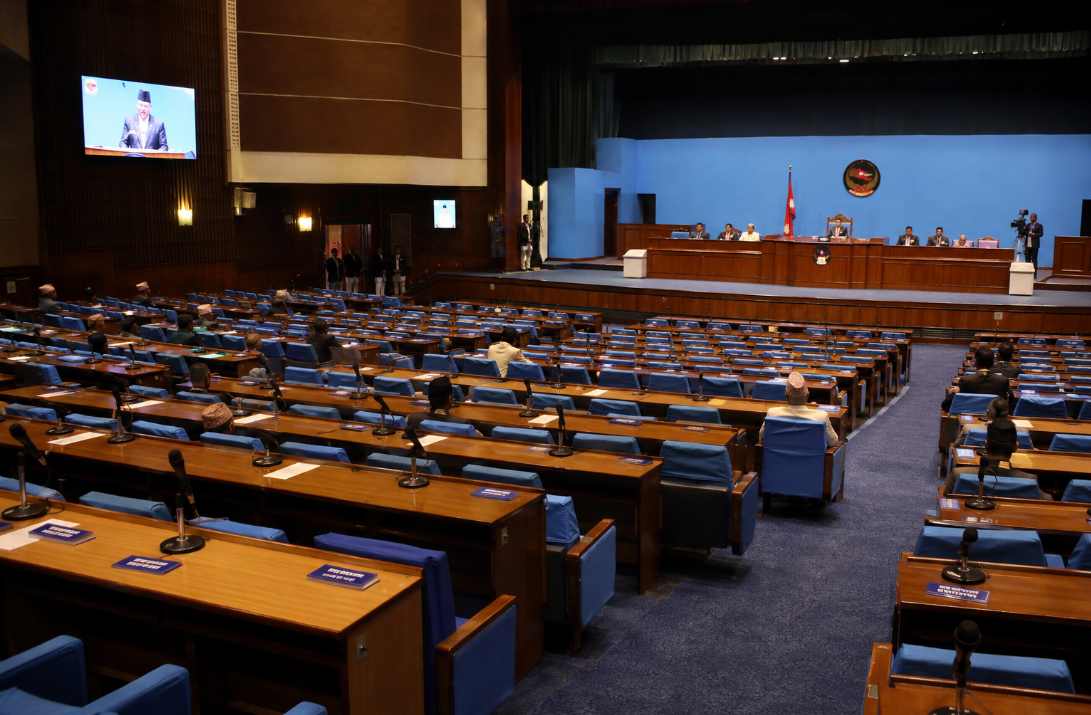
At the House of Representatives meeting held on Shrawan 26, Industry Minister Gauri Kumari Yadav presented a mining-related bill. However, the bill could not be passed because there was not even the required quorum. Only 61 of the 275 lawmakers were present in the House, whereas 169 lawmakers are required to pass a bill.
It has been nearly six months since the election. During this period, not even a dozen bills have been passed by Parliament.
The state spent Rs 20 billion to conduct the election. Every day, tens of millions of rupees are spent on salaries, allowances and other facilities for lawmakers and parliamentary employees. The job of lawmakers is to formulate laws. Unfortunately, the current lawmakers do not appear responsible toward this duty. Speaker Dol Prasad Aryal is also considered close to the ruling side, so he is neither able to issue strict instructions to lawmakers nor issue effective rulings to the government.
Meanwhile, Prime Minister Balen also does not appear sensitive or responsible toward the country and its people. Decisions in the interests of the country and the public are not being made by the Cabinet. These days, even Cabinet meetings are being held only once every one or two weeks. The Prime Minister should instead hold Cabinet meetings regularly and make decisions one after another in the interests of the country and its people and instruct officials to implement them.
The people gave the RSP an almost two-thirds majority because they believed that the Nepali Congress, CPN-UML, Maoists and Madhesh-based parties had done nothing for 35 years. Ironically, the RSP government now appears to be no different.
In the past, whenever there was a need to investigate or inquire into an incident, commissions, task forces or committees were formed. However, their reports were often kept hidden. Reports such as the Mallik Commission report, Rayamajhi Commission report, Bhairav Lamsal property investigation report, Lal Commission report, the 38-kg gold smuggling investigation, the 61-kg gold smuggling investigation, reports concerning government and public land, the report on reducing secretary-level positions, the High-Level Salary and Facilities Commission report, the report on irregularities at the Social Welfare Council, the report on strengthening the Office of the Prime Minister, and recommendations for institutional reform were among those kept hidden during previous governments.
After the Balen government was formed, the public had expected these reports to be made public and implemented. However, even after nearly five months of the government being in office, there appears to be no attention toward this issue.
In 1964 B.S., the then King Mahendra introduced the Land Act. The law stipulated that individuals or institutions could not own more than 10 bighas of land in the Terai, 25 ropanis in the Kathmandu Valley and 70 ropanis in the hills, and that land exceeding the prescribed ceiling would belong to the state.
In Ward No. 7 of Madhyapur Thimi Municipality in Bhaktapur, an individual, Devrajyalakshmi Rana, reportedly owned more than 200 ropanis of land. Since land ownership in the Valley is limited to 25 ropanis, this land should have belonged to the state. However, private houses and buildings have now been constructed on the land. Private individuals are enjoying land that should belong to the state.
This is only one example. Across the country, government land, guthi land, public land, land exceeding legal ownership limits, land belonging to temples and monasteries, royal family property, riverbanks and other public properties have ended up in private hands. Houses and other structures have even been built after destroying historical heritage sites.
The question has now arisen as to whether the Balen government has failed to notice these issues or has deliberately chosen to ignore them.
When Balen was the mayor of Kathmandu Metropolitan City, he had gained popularity for protecting public land and property. Meanwhile, large areas of Nepal’s territory have been claimed or occupied by India and China. Nepal has already lost territories including Darjeeling, Sikkim, Tinkar, Hajipur, Baghgham, the Teesta-Kangra region, Gorakhpur, Patna and areas extending toward the Munger River. There are now concerns over Kalapani, Limpiyadhura and Lipulekh as well.
In Kathmandu’s Bhrikutimandap area, 217 ropanis of land belonging to the Social Welfare Council are being used by businessmen. The land has reportedly been occupied at extremely low rates. In Gongabu, the Lotse Cooperative has leased 161 ropanis of land at a very low rate and is operating a bus park. Lotse reportedly earns billions of rupees every month while paying only millions of rupees annually to the Kathmandu Metropolitan City.
The 129-anna historical Vajradhatu Chaitya and public grazing land in Thamel have also reportedly been taken over by private individuals. Across the country, wells, canals, stone spouts, royal canals, Tukucha streams, lakes, ponds, irrigation areas, rest houses, public shelters and other public spaces have been destroyed and replaced with private houses and other structures.
During previous governments, government land and heritage properties were allegedly seized through collusion among government employees, political party leaders and land mafias. Unfortunately, the Balen government has not appeared to investigate or search for such land and heritage properties. Although it claims to be a new government, the same old pattern of work appears to be continuing. This has raised doubts about whether the government actually wants to work at all.
Otherwise, why has there been no significant work in the interest of the country and its people even after several months since the government was formed?
There has been a syndicate in the transportation sector for a long time. New registrations for green- and black-plated taxis, four-stroke tempos, transport vehicles and other vehicles have been closed for four decades. The public had hoped that the Balen government would break the transportation syndicate and reopen new taxi registrations.
However, that hope has also turned into disappointment. This has further strengthened the confidence of those benefiting from the syndicate. At present, number plates of 20-year-old taxis and gas-powered tempos are reportedly being bought and sold for Rs 1.7 million.
Gas-powered tempos were brought into Nepal in fiscal year 2051/52 with a complete customs exemption. A tempo worth Rs 700,000 could then be purchased for around Rs 300,000.
By operating or renting out those tempos, their owners have already earned millions of rupees over 20 years. Now, the number plates of those same tempos are reportedly being traded for Rs 1.7 million.
The saeis true of taxis. In 2048 B.S., the government allowed taxis to be imported with a complete customs exemption. Millions of rupees were earned over 20 years from taxis that had been purchased for around Rs 200,000. Now, their number plates are reportedly being traded for Rs 1.7 million.
Despite this, the government has paid no attention to the issue.
There was great public hope that the Balen government would work. That is why voters gave the RSP such a large number of seats in the election. Ironically, widespread disappointment has now spread among the public. Government and parliamentary activities are beginning to increase public anger.
The government also appears to be preoccupied with the transfer, promotion and appointment of government employees and the approval of foreign loans.
The previous government had already accumulated Rs 3.2 trillion in foreign debt. This government has taken an additional Rs 4 billion in loans within just four months. The country is already burdened with debt. The government still owes Rs 56 billion to construction entrepreneurs, Rs 43 billion for health insurance, Rs 24 billion for coronavirus insurance, and Rs 7 billion in outstanding payments to dairy and sugarcane farmers.
The Gen Z movement held on Bhadra 23 and 24, 2082 B.S. caused damage estimated at Rs 84.7745 billion to government property. Private property suffered losses estimated at Rs 2.7 trillion. Rebuilding these structures will require more than twice the amount of the damage itself.
There were hopes that the Balen government would arrest corrupt individuals and those involved in tax evasion and use recovered funds to rebuild the damaged infrastructure. That has not happened either. This suggests that the government is also gradually moving toward failure.
Express



Related News

The struggles and unappreciated contributions of national players
Preface
The words of honor, identity and pride of the nation are not limited to the pages of history. Even today, they are born again and again in the playground. When a player sweats on the field carrying the nat...

Political interference: The main obstacle to sports development
© Madan Singh Bhatt
Sport is the creation of human life, where there is dialogue between body and soul.
Sports is not just about sweat, it is about willpower, discipline and self-respect.
But whe...
Rent, Water, Electricity, Garbage, and Parking: Landlords Overcharging Tenants as All Three Levels of Government Avoid Setting Fee Standards
Bhaktapur – The government has fixed the electricity tariff that consumers must pay. The Nepal Electricity Authority charges landlords Rs. 9.40 per unit, but many landlords reportedly charge tenants between Rs. 18 and Rs. 30 per unit, earning a pr...

Government Employees Enjoy Benefits While the State Struggles, Public Faces Growing Financial Despair
By Rusha Thapa______
Bhaktapur_ The Government of Nepal continues to provide monthly pensions to retired civil servants, with payments typically deposited into beneficiaries' bank accounts before the 10th of each month. Depending on t...

Concerns about declining agro-biodiversity and increasing food security in rural households
Kathmandu. "How much will the millet grow this year, mother?"
"Where is the father! It has been two or four years since the seeds were planted."
"The wheat just disappeared! The market seed left one year and...

A mansion-like house, covered in gold jewelry, yet starving because there is no cooking gas!
Rusha Thapa
Bhaktapur. Four decades ago, Nepal was largely self-sufficient in almost everything. We had enough of our own food, timber and other necessities. Almost every person had farmland or some kind of land. People produced the grains a...