By Rusha Thapa
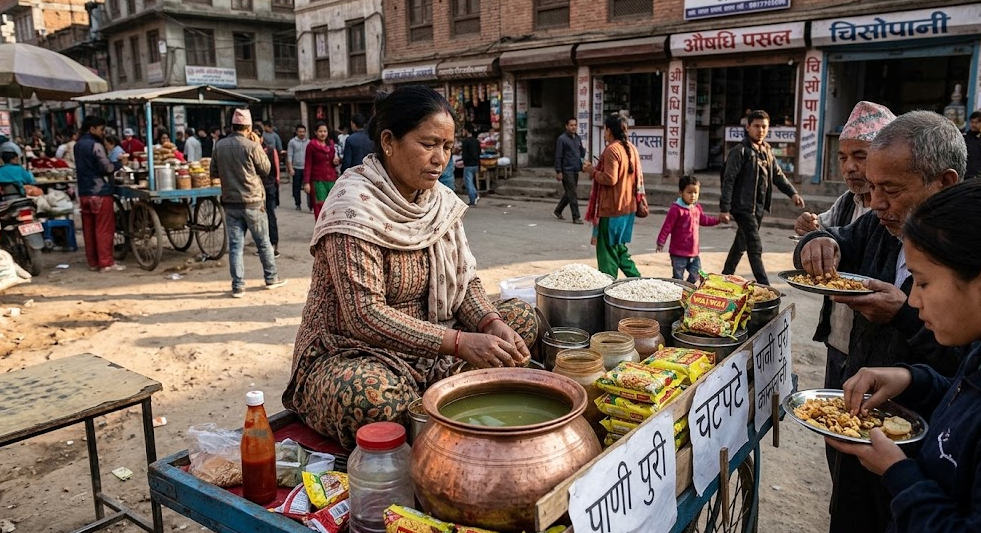
Bhaktapur. The business of Chatpate and Panipuri has flourished extensively over the past few years both inside and outside the Kathmandu Valley. These businesses are run either by renting shutters or on pushcarts. Depending on the location, a single plate of Chatpate or Panipuri costs anywhere from 60 to 200 rupees. Everyone from students to government employees can be found eating Chatpate and Panipuri.
Some parents can also be seen feeding these to their children. What is the sauce used in Chatpate made from? What kind of water is used to prepare the Panipuri soup/water? What is added to make Chatpate and Panipuri so delicious? Most people simply do not know. People seem to consume Chatpate and Panipuri merely for flavor and the satisfaction of their taste buds.
On the other hand, those who prepare Chatpate and Panipuri are often unhygienic themselves. They do not bathe for months. Their hands are not clean, and they prepare Chatpate and Panipuri without wearing gloves. Despite witnessing all of this, even educated individuals continue to consume such items. The various diseases appearing in people recently are partly due to such foods.
The sauce or food coloring used in Chatpate causes severe harm to the human body because it is mixed with chemicals. The Panipuri water is made using dirty water. Ingredients like Ajinomoto (MSG), which erodes bones, are used in it. After consuming such food, people end up suffering from chronic illnesses. Satisfying the palate ultimately harms the entire body.
Not only that, it drains both money and health. What is ironic is that the educated class—such as government officials, who ought to raise awareness against consuming such food—are themselves caught eating Chatpate and Panipuri. They feed it to their children as well, only to regret it later when diseases strike.
Some people have even built mansion-like houses solely through the Chatpate and Panipuri trade. They generate daily sales ranging from five thousand to hundreds of thousands of rupees. The cost is extremely low while the profit margin is very high, allowing them to accumulate tens of millions in assets within a few years. Yet, they do not pay a single penny in taxes to the state. If market conditions were to be monitored, most Chatpate and Panipuri shops would be found unregistered.
Cart vendors are naturally unregistered, but even many Chatpate and Panipuri shops operating out of rented shutters remain unregistered. In this way, they conduct business without registration, harm public health, and evade state taxes. Unfortunately, state authorities do not seem to pay attention to this issue. Even when traders cheat the public and put their lives at risk for personal profit, the government remains silent. Government bodies perform neither market inspections nor enforce penalties. This issue is not limited to Chatpate and Panipuri; it exists in other food products as well. Various chemicals are even mixed into curd and milk.
Juju Dhau (King Curd) in Bhaktapur is famous. Both domestic and foreign tourists come here to taste this curd, yet many end up carrying a burden of diseases from consuming it. People are being served and consuming chemicals under the label of Juju Dhau, as various chemicals are added to set the curd—a fact unknown to both the general public and the state. Milk is also adulterated with milk powder.
The condition of sweet shops is equally deplorable. As attractive, clean, and nice as a sweet shop looks from the outside, the area where the sweets are prepared is just as dirty. Sweets are prepared while stomping with feet. The utensils used for making sweets are filthy, and dead mice and insects are often found in them. If one were to see the preparation process, far from eating, one wouldn't even want to look at the sweets.
This is why traders make sweets in one place and sell them in another. Lately, when people feel thirsty, they consume soft drinks rather than water. Nowadays, everyone drinks Coke, Fanta, and Red Bull. These beverages are made with excessive sugar and chemicals that cause extensive damage to the human body.
Whether imported or home-brewed, alcohol is widely available in the market. People take refuge in alcohol when stressed or when celebrating. What is imported alcohol made of? No one knows, but home-brewed alcohol is made using animal bones, old and dirty shoes, socks, clothes, urea fertilizer, and more. Consuming such alcohol directly destroys sensitive human organs like the liver, kidneys, and lungs.
This is precisely what has been happening recently. Many people can be found undergoing treatment in hospitals due to the failure of vital organs such as kidneys and lungs. Some are even seen begging on the streets because they lack money for treatment. Today, everyone from children to the elderly loves eating momo, chowmein, burgers, and pizzas.
However, what are these foods made of? What kind of meat is used? Nobody knows. Two decades ago, a momo shop in Koteshwor, Kathmandu, was found using dog meat to prepare momos. Cockroaches are also found inside momos. When meat shops sell uncastrated goats (boka) as castrated goat meat (khasi), or dead chickens and dogs as fresh chicken, can we expect momo shops to use good quality meat?
Furthermore, the condition of donut shops, bakeries, and bread manufacturing industries is similar. Harmful powders are used to make donuts and bread rise. Donuts, nimki, and potato chips are fried in the same reusable oil. Cakes are made using rotten eggs, numerous chemicals, and food coloring. Spoiled fish is preserved with chemicals and sold for months. Even jarred drinking water contains chemicals.
While people are falling ill from consuming such food, medicines are also inviting diseases. Pharmaceutical traders sell expired medicines, leading to further ailments on top of existing ones. While traders play with the lives of the general public for personal gain, the state remains silent. Protecting the lives and property of citizens is the duty of the state. Sadly, as the government shirks its responsibility, citizens are losing both their money and their lives. Therefore, the government must pay attention to the market now; otherwise, the state itself will have to bear a massive loss.