
Civil Servants Themselves Causing Loss to the Nation While the Government Remains a Spectator
-
Media Baaji

- Mon, 3 August 2026

By Rusha Thapa
Bhaktapur – Around two decades ago, the Transport Management Service Office was established near Sallaghari Threekune Chowk in Bhaktapur. Operating under the Ministry of Transport of Bagmati Province, the office has been functioning from a rented private building since its establishment. The government has been paying a monthly rent of approximately NPR 150,000 for the building, despite the fact that similar and more convenient buildings in the same area are available for just NPR 10,000 to 15,000 per month.
The building lacks even basic facilities, including open space for vehicle parking, forcing service seekers to struggle to find parking every day. Located inside a narrow alley, the office is also difficult for visitors to locate. This raises an important question: why has a government office continued operating from such an unsuitable building for nearly twenty years?
Since its establishment in 2007 (2064 B.S.), the office has remained in the same rented building, even though more suitable and less expensive alternatives exist nearby. The issue demands the attention of the federal government, as the building owner and office leadership are accused of prioritizing personal interests over public welfare, causing financial loss to the state and inconvenience to citizens.
Because there is no parking space within the office premises, visitors are forced to park their vehicles at or around Threekune Chowk. Parking charges are collected by Bhaktapur Municipality, although the land belongs to Nepal Trust. The current parking fees include NPR 10 per hour for motorcycles, NPR 25 for four-wheelers, and NPR 300 for buses and trucks.
The owner of the building where the office operates is reportedly a politically influential individual who has managed to keep government offices in his property for years. When authorities attempted to relocate the office, he allegedly used his influence to stop the move.
In Baisakh 2081 (April–May 2024), the Bagmati Province Ministry of Transport decided to relocate the Sallaghari Transport Office to Koteshwor, partly because another transport office already operates in Radheradhe, just five minutes away. The Radheradhe office is also housed in a rented building without proper facilities, including parking, while paying nearly NPR 200,000 in monthly rent.
Since both offices perform similar functions and are located within a short distance of each other, the ministry instructed the Sallaghari office to relocate. However, instead of implementing the decision, Office Chief Badri Prasad Niraula allegedly encouraged the landlord and local business owners to oppose the relocation and supported legal action to prevent the transfer.
The presence of the transport office has significantly increased property values in the surrounding area. Rooms that previously rented for around NPR 2,000 now fetch between NPR 7,000 and NPR 15,000 per month. Shop rents range from NPR 50,000 to NPR 200,000, while apartment rents vary from NPR 30,000 to NPR 150,000. Businesses such as stationery stores, tea shops, fruit vendors, grocery stores, and photo studios have flourished because of the office, with some reportedly earning hundreds of thousands of rupees daily.
Local business owners fear that if the office is relocated, their businesses will suffer and property values will fall sharply. Critics therefore allege that the office chief has actively worked with landlords and local traders to prevent the relocation.
Government regulations reportedly require rented government offices to be relocated every two years. Nevertheless, the Sallaghari Transport Office has remained in the same building for nearly twenty years without any action from the authorities. Local residents claim that the office will never be relocated because, according to them, "everything has already been managed" by the office chief.
Despite these allegations of causing financial loss to the state, neither disciplinary action nor a transfer has been taken against the office chief. As a result, critics argue that while he has succeeded in protecting his interests, the burden continues to fall on taxpayers through excessive rental payments and on citizens through poor public service.
There re also claims that the office and much of the surrounding area stand on public land. According to local elders, cadastral records prepared in 2021 B.S. classified the land as public property. They say that the area once contained traditional stone water taps and irrigation canals used by local residents for drinking water, washing clothes, and bathing. Today, a large private house owned by Bikulal Khiju reportedly occupies that site, with allegations that the historic water structures were destroyed during construction.
Residents further allege that numerous government, trust, and public lands throughout Bhaktapur have been illegally occupied over the years. They claim that political leaders, government officials, and elected representatives worked together to transfer public land into private ownership.
Areas including Sallaghari Army Barracks, Changa Ganesh, the roads toward Duwakot and Kharipati, Nikosera, Sirjana, and Radheradhe were reportedly recorded as government, trust, public, wetland, or cremation land. Today, however, these areas are almost entirely covered by private buildings whose owners possess land ownership certificates. Critics question how such public land was converted into private property.
The article also alleges that even land formerly owned by Nepal's royal family was not spared. It claims that King Mahendra purchased 110 ropanis of land in Sallaghari Threekune in 1967 (2024 B.S.) for NPR 1,000 per ropani. Although official documents recorded the property as 110 ropanis, locals claim its actual area was around 145 ropanis.
Following the abolition of the monarchy in 2008 (2065 B.S.), the land came under the management of Nepal Trust. However, critics allege that inadequate protection allowed portions of the land to be encroached upon.
In 2017 (2074 B.S.), the Ministry of Finance reportedly allocated NPR 30 million to Bhaktapur Municipality to construct a boundary wall around the property. According to local residents, the municipality built walls and six gates without conducting a proper land survey. They allege that the actual construction cost was no more than NPR 2.5 to 3 million and claim that the remaining funds were lost to corruption.
The article concludes by questioning who will address these irregularities in Bhaktapur, alleging that while the federal government remains inactive, government employees and public representatives continue to cause financial losses to the state.
Express


Related News

Concerns about declining agro-biodiversity and increasing food security in rural households
Kathmandu. "How much will the millet grow this year, mother?"
"Where is the father! It has been two or four years since the seeds were planted."
"The wheat just disappeared! The market seed left one year and...

Common people and traders are not excited about the New Year, inflation and recession!
Rusha Thapa
Bhaktapur. The new year has begun. However, more than the excitement of the new year, there is concern among the common citizens. There is widespread talk about the market becoming more expensive in 2083. Common people say that t...

The art of winning is “madness” as long as you don’t give up - DR Dahal
The journey of life is uncertain, challenging and full of difficulties. We all face the problem of never seeming to succeed and many failures. However, the trials of life are the real test of one's determination, courage, and self-strength. Decide...

In the name of cheating in the name of foreign employment and education, even the Balen government could not shut down!
Kathmandu. Recently, the number of people going for foreign employment has increased rapidly. As there is not enough employment in the country, foreign employment has become the mainstay of Nepalese. However, fraud in the name of foreign employmen...

Players should not ask for help, the nation should take responsibility
Madan Singh Bhat
Youth leader and sports analyst
Savitra Bhandari (Samba), the captain of the Nepali National Women's Football Team and the pride of the country, is currently facing the toughest struggle of her life. S...
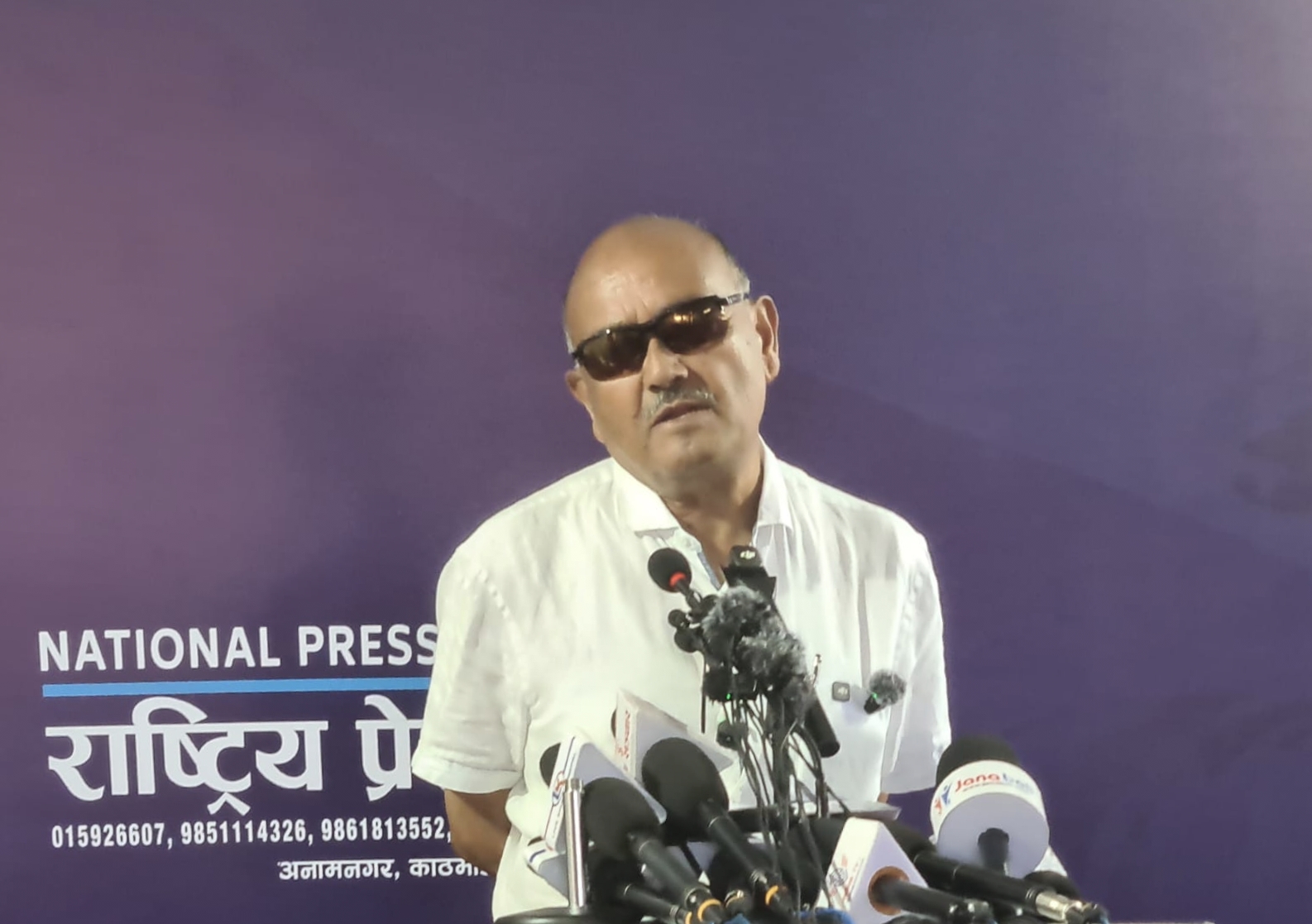
"Not the constitution, character revision is necessary" : Prof. Dr. Surendra KC
Mediabaaji.com Kathmandu, July 24. Analyst Prof. Dr. Surendra KC has said that "revision of character" is the main need of present Nepal rather than amendment of the constitution. Speaking at an interaction program held at the National Press Club,...