
Government Claims Public Transport Fares Have Not Increased, but Passengers Say They Are Paying Up to Rs. 500 More Than Before
-
Media Baaji

- Wed, 14 October 2026
By Anusa Thapa
Bhaktapur, Nepal — The government claims that public transport fares have not increased. But is that really the case? Passengers preparing to travel home for Dashain tell a different story.
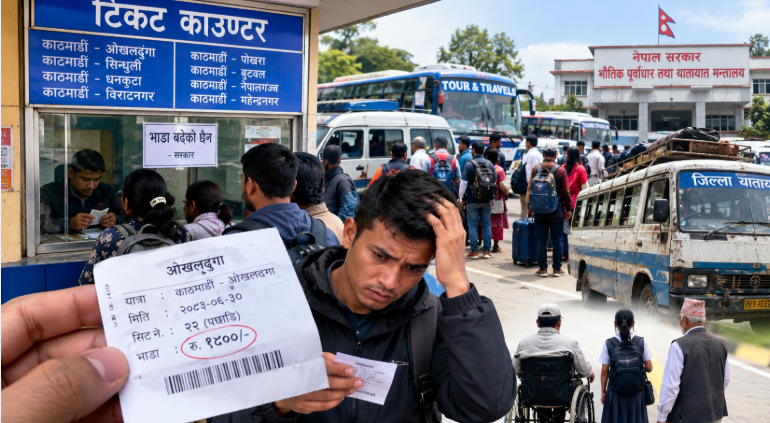
“One month ago, I paid Rs. 1,400 for the journey, but this time I had to pay Rs. 1,800,” said a passenger leaving a ticket counter in Chabahil. Showing his ticket, he explained that he had purchased a ticket to Okhaldhunga. He had finally managed to get a ticket for the 30th, but only for a rear seat. Compared with his previous journey, he had to pay an additional Rs. 400.
Similar complaints are being reported by passengers purchasing tickets at Kalanki, Jadibuti, Balkhu, Balaju Machhapokhari and Gongabu Bus Park. Many say they are being charged between Rs. 200 and Rs. 500 more than before. Although the government insists that public transport fares have not been officially increased, ticket counters appear to be collecting additional amounts. Passengers are questioning why authorities have failed to monitor the situation.
During the Dashain travel rush, passengers are reportedly facing multiple forms of exploitation. Students, persons with disabilities and senior citizens are allegedly being denied the discounts they are entitled to receive. Some passengers are being charged full fares, while tickets are reportedly being issued for seats that may not exist. Additional charges are also being collected for luggage, including suitcases.
Although passengers’ names are written on tickets, essential details are missing. The tickets reportedly do not clearly identify the vehicle’s registration number, age, driver, owner, chassis number or engine number. As a result, passengers have little information about the vehicles in which they are travelling.
With the government opening up route permits for Dashain travel, passengers may be transported to different districts in old vehicles that were previously operating within the Kathmandu Valley. Some of these vehicles are reportedly between 23 and 35 years old.
The transport offices responsible for issuing temporary route permits, commonly known as patke permits, have reportedly been closed since Sunday. According to the information provided, these offices will remain closed until the day after the full moon. Critics question why government offices responsible for collecting public revenue have been closed during one of the busiest travel periods of the year.
Many jumbo HiAce vans and microbuses travelling to different districts reportedly do not possess the necessary route permits and have instead been operating on temporary permits. With the temporary permit offices closed, concerns have arisen about whether some vehicles are travelling without completing the required procedures or paying the necessary government fees.
Some small vehicles reportedly obtain temporary permits for routes in Sindhuli and then travel as far as Jhapa. Critics argue that the government has failed to take effective action against such practices while allowing vehicles to travel more freely during Dashain without adequate oversight.
The issue raises serious questions about passenger safety and insurance coverage. Under the applicable rules, vehicles operating outside their permitted routes may face problems obtaining insurance compensation if an accident occurs. If passengers are killed or injured in an accident involving a vehicle operating outside its authorised route, their families could face difficulties receiving compensation, depending on the circumstances and applicable insurance terms.
Critics argue that if the government allows vehicles to travel beyond their authorised routes during the festival season, it should ensure that the necessary temporary permits and safety requirements remain in place. Simply opening routes without maintaining appropriate oversight could leave passengers exposed to unnecessary risks.
The movement of vehicles from the Kathmandu Valley to various districts has also reportedly created a shortage of public transport within the Valley. The number of vehicles on the roads has decreased, leaving passengers waiting for hours. Some are already facing overcrowding and being forced to travel while hanging from vehicle doors.
The issue of ageing vehicles has also raised concerns about school transportation safety.
On August 19, 2014, the Cabinet decided to phase out public vehicles that had reached 20 years of age. The decision was published in the Nepal Gazette on March 2, 2015. However, according to the allegations raised in the report, some vehicle owners deregister vehicles shortly before they reach the 20-year limit and subsequently register them under private number plates.
Some of these vehicles are then used to transport schoolchildren. The report points to a recent tragic incident in Pokhara in which students lost their lives, highlighting concerns about the safety of vehicles used by schools.
Some private schools reportedly purchase such vehicles at low prices, while others rent them. Critics argue that the government should also enforce appropriate age and safety standards for privately registered vehicles used for school transportation. They say the failure to regulate such vehicles adequately places children at risk.
Parents are also being urged to ask questions about the vehicles used to transport their children, including how old the vehicles are and whether they meet the required safety standards. As accidents involving school vehicles continue to raise concerns, questions have been directed at the Ministry of Education, the relevant education authorities and the Department of Transport Management over their monitoring and enforcement responsibilities.
The report further alleges that some schools charge substantial transportation fees while using old vehicles. School bus fares are generally determined by individual schools rather than through a uniform government-set rate, and concerns have been raised about the lack of effective regulation.
According to the allegations, some schools charge between Rs. 5,000 and Rs. 30,000 per student for transportation. Although buses may require investments of between Rs. 2 million and Rs. 5 million, the report claims that some operators generate monthly revenues worth lakhs of rupees without adequately meeting their tax obligations.
Similar concerns have been raised about tourist buses operating with green number plates. Critics allege that some operators collect fares without sufficient regulation and fail to comply with requirements concerning route permits, vehicle inspections and pollution testing. The report questions why the Department of Tourism has not taken stronger action against alleged irregularities involving tourist vehicles.
Taxi fares have also reportedly increased sharply during the Dashain rush.
As people hurried to reach bus stations, taxi drivers were in high demand. One example cited in the report involves a taxi bearing registration number Ba 2 Ja 3693, whose driver reportedly demanded Rs. 1,500 for a journey from Ghattekulo to the New Bus Park.
The report also alleges that taxi drivers charge significantly higher rates for trips to districts during the festival period. A journey that might normally cost around Rs. 5,000 could reportedly cost between Rs. 15,000 and Rs. 20,000 when passengers hire a taxi for the entire trip during Dashain.
Another issue is the limited availability of taxis in the Kathmandu Valley. The government has not opened new registrations for conventional black-plated taxis for a long time. Despite the Valley’s population approaching the scale of several million residents, the report puts the number of black-plated taxis at approximately 9,000. It also states that only 207 green-plated taxis operate at the airport.
Repeated demands to open registration for black-plated and green-plated taxis, four-stroke tempos and goods-carrying vehicles operating in Kalimati have reportedly gone unanswered.
Meanwhile, registration numbers associated with scrapped 20-year-old taxis, gas-powered tempos and microbuses are allegedly being traded for as much as Rs. 2 million.
Critics argue that opening new vehicle registrations would generate government revenue, create employment opportunities and improve access to affordable transportation. They say that a more competitive transport market could reduce passenger difficulties and limit the ability of existing operators to charge excessive fares.
The misuse of government vehicles has also become a subject of criticism during the festival season.
On Sunday, government vehicles bearing white number plates were reportedly seen at Sallaghari being used to purchase goats and Himalayan mountain goats, known as chyangra, for Dashain celebrations.
The government introduced Sunday holidays with the stated aim of reducing fuel consumption. However, allegations persist that government employees and elected representatives continue to misuse official vehicles for personal purposes. Critics say the additional holiday may create further opportunities for such misuse, including travelling home for Dashain or shopping with government vehicles.
Questions have therefore been raised about who is responsible for monitoring the use of vehicles funded by taxpayers.
The report argues that ordinary passengers are being exploited by transport operators while public officials are allegedly misusing public resources. It questions who will hold those responsible accountable.
The article also expresses disappointment with the Balen-led government. Voters gave the party 182 seats, expecting significant changes in governance and public service delivery. However, the writer argues that the government has not yet delivered the improvements many citizens had anticipated.
With Dashain travel placing additional pressure on Nepal’s public transport system, passengers are demanding effective monitoring of ticket prices, enforcement of transport regulations, safer vehicles, protection of passenger rights and accountability from both transport operators and government officials.
The central question remains: if the government insists that fares have not increased, why are so many passengers reporting that they are paying hundreds of rupees more for the same journeys?
Express



Related News

Rising Unemployment Leaves More Young People Unmarried, While Pensioned Employees Continue Marrying Even in Old Age
Rusha Thapa
Bhaktapur, In recent times, many young people have chosen not to enter into marriage because of unemployment. Even those who have jobs often do not want to marry because their income is insufficient. Since they find it difficult...

The Finance Minister Himself Is Trying to Drown the Public: Think Carefully Before Investing in the Stock Market!
By Rusha Thapa
Bhaktapur. According to the law, no person or business is allowed to make a profit of more than 20 percent of the production cost of any goods or services. In other words, a product that costs Rs. 100 to produce can be sold fo...
Citizens Trapped by Debt, Government Sinking the Country Under Foreign Loans!
By Anusha Thapa
Over the past five years, cases of banking offenses in Nepal have risen sharply, with bounced checks and financial transaction disputes accounting for the majority. The primary reason behind this surge appears to be the prolo...

Unimplemented Genji Report Repression Recurred: Genji Agua Hamal
Kathmandu. Ravi Kiran Hamal, the leader of the Genji movement, met with the Commissioner of the National Human Rights Commission, Lily Thapa, and discussed in detail the implementation of the commission's report on the Genji movement, the state of...
Two Laws Under One Government: Banks Can Charge Any Interest They Want, Individuals Face Jail
By Anusha Thapa
One government, but two different laws. The issue is interest rates. The government allows banks and financial institutions to determine their own interest rates. Banks, finance companies, cooperatives, and micr...

Players should not ask for help, the nation should take responsibility
Madan Singh Bhat
Youth leader and sports analyst
Savitra Bhandari (Samba), the captain of the Nepali National Women's Football Team and the pride of the country, is currently facing the toughest struggle of her life. S...